


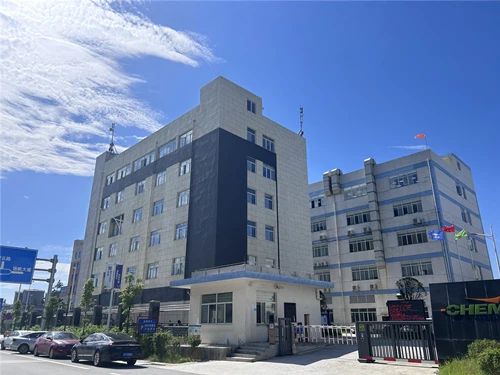
YUEYANG CHEM WATERBORNE ADDITIVE CO., LTD. was established in 2010 and is located in Yueyang, Hunan. It specializes in the R&D, production and sales of environmentally friendly additives. CHEM-ADDITIVE has technical teams for chemical analysis, chemical synthesis and additive application, and has established extensive industry-university-research cooperation with scientific research units such as Huazhong University of Science and Technology, Wuhan University, Hunan University, and Central South University of Forestry and Technology.
Why Choose Us
Our factory
YUEYANG CHEM WATERBORNE ADDITIVE CO., LTD. was established in 2010 and is located in Yueyang, Hunan. It specializes in the R&D, production and sales of environmentally friendly additives.
Product application
CHEM-ADDITIVE is committed to waterborne green environmental protection in the coatings, inks, adhesives and other markets, and provides corresponding solutions.
Production equipment
In order to ensure product quality, the company is equipped with advanced testing instruments, including Agilent 5890 gas chromatograph and gas phase-linked mass spectrometer, Mettler-Toledo acidity meter, and German SITA dynamic surface tension meter.
Our certifications
The company has passed the international ISO9001:2015 quality management system certification and IS014001:2015 environmental management system certification, as well as the EU chemical industry's joint efforts to achieve sustainable development Tfs certification, 16949 automotive industry quality management system and reach registration, all of which have contributed to the company's sustainable operations and Stable and reliable product quality provides institutional guarantee.

Acrylate-Based Leveling Agent is a type of surfactant derived from acrylate compounds, designed to enhance the flow and leveling properties of coatings, inks, and other liquid materials.

Fluorine-modified Leveling Agent
Fluorinated Leveling Agent is a type of leveling agent modified with fluorinated groups, designed to enhance the flow and leveling properties of coatings and other liquid materials.

Linear Polyether Modified Siloxane Leveling Agent
Linear Polyether Modified Siloxane Leveling Agent is a type of leveling agent modified with linear polyether and siloxane components.

Branched Polyether Modified Siloxane Leveling Agent
Branch-Chain Polyether Modified Siloxane Leveling Agent is a type of leveling agent made by incorporating branch-chain polyether structures into siloxane groups.

Pure Acrylic Ester Leveling Agent is a type of leveling agent made from polymerized acrylic ester monomers.

Modified Acrylate Leveling Agent
Modified Acrylic Ester Leveling Agent is a leveling agent made from chemically modified acrylic ester monomers.

Fluorine-modified Siloxane Leveling Agent
Fluorinated Siloxane Leveling Agent is a type of leveling agent modified by incorporating fluorine atoms into siloxane molecules.

Fluorocarbon Compound Leveling Agent is a type of leveling agent that contains fluorocarbon groups in its molecular structure. Known for its exceptional surface properties and stability..

Solvent-Based Leveling Agent is a type of leveling agent dissolved in organic solvents, primarily used to adjust the flow and application properties of coatings.
What Is Organic Silicon Leveling Agent
Silicone leveling agent are used very common in coating and ink. It can help reducing the surface tension of the coating film. It can also eliminate the difference of surface tension and make a good surface state for the coating film. It can prevents bernard swirl, orange peel and shrinkage holes of coating film. By decreasing the surface tension, the spreadibility of coating can be improved as well as the adhesion. Silicone leveling agent are used very early and very often in the coating and ink industry.

Lower surface tension
These leveling agents consist of organic silicone compounds that have low surface tension, which allows them to migrate more rapidly to the surface of the paint film.
Form a monomolecular film with a constant surface tension
During the drying process of the paint film, leveling agents can migrate to the surface of the film and form a monomolecular film with a constant surface tension that does not change with the film forming process. With the help of leveling agents, the surface tension of the paint film can be kept constant, and the film can gradually reach a relatively smooth surface without disturbance under its own driving force.
Leveling agent is a commonly used coating additive, it can promote the coating to form a smooth, smooth, uniform coating film in the drying film formation process. A substance that can effectively reduce the surface tension of the coating liquid and improve its leveling and uniformity. It can improve the permeability of the coating liquid, reduce the possibility of spots and marks during brushing, increase coverage, and make the film formation uniform and natural. Mainly surfactants, organic solvents, etc. There are many types of leveling agents, and different types of leveling agents are used in different coatings. High-boiling solvents or butyl cellulose can be used in the solvent-based finishing agent. In water-based coating agents, surfactants or polyacrylic acid, carboxymethyl cellulose, and the like are used.
Leveling agents fall into two broad categories. One is by adjusting the viscosity of the paint film and the leveling time. Most of these leveling agents are high-boiling organic solvents or their mixtures, such as isophorone, diacetone alcohol. The other it works by adjusting the surface properties of the paint film. Generally speaking, the leveling agents generally refer to this type of leveling agent. This type of leveling agent migrates to the surface of the paint film through limited compatibility, affecting surface properties such as the interfacial tension of the paint film, so that the paint film achieves good leveling. According to different chemical structures, there are three main types of leveling agents: Acrylics, silicones and fluorocarbons.

The Leveling Principle of Organic Silicon Leveling Agent
The leveling principle of silicone leveling agent: surface tension is the main driving force for the leveling of the coating film, but the poor surface tension is the main source of the surface defects of the coating film. Improve the surface tension of the coating film to achieve a balance of surface tension, which is very beneficial to the flow and leveling of the coating film, but it cannot be done. Therefore, people have to reduce the surface tension of the coating film to eliminate the difference in surface tension, control the surface state of the coating film, and eliminate surface defects.
Surface tension is the main driving force for coating film leveling, but poor surface tension is the main source of coating film surface defects. Improve the surface tension of the coating film to achieve a balance of surface tension, which is very beneficial to the flow and leveling of the coating film, but it cannot be done. Therefore, people have to reduce the surface tension of the coating film to eliminate the difference in surface tension, control the surface state of the coating film, and eliminate surface defects. Such as eliminating the Benal vortex, preventing the production of flowers and orange peel. Eliminate the difference in surface tension gradient on the surface of the coating film, and prevent the generation of shrinkage holes and ripples. Reduce the interfacial tension between the coating and the substrate, enhance the spreadability of the coating, improve the adhesion, and reduce or eliminate the shrinkage caused by the substrate. Silicone oil and organically modified polysiloxane are a kind of surface condition control agent that has been used earlier and widely used in the coating industry, and can basically eliminate surface defects caused by poor surface tension.
The modification methods of organosilicon leveling agents are different, the modified materials are different, the structure is different, the molecular weight is different, and the application is also different. Therefore, pay attention to the following points when applying.
Applications of Organic Silicon Leveling Agent
Paints and coatings
Silicone leveling agents are frequently added to paints and coatings formulations to improve flow and leveling properties. They help reduce surface tension, allowing the coating to spread evenly and form a smooth film. This is particularly important in high-gloss finishes where even minor imperfections are noticeable.
Inks
In the printing industry, silicone leveling agents are used in ink formulations to ensure uniform coverage and reduce mottling or streaking during printing processes. They help in achieving consistent print quality on various substrates.
Adhesives and sealants
Silicone leveling agents can be incorporated into adhesive and sealant formulations to improve wetting and spreading properties. This helps in achieving better adhesion and sealing performance while ensuring a smooth and uniform bond line.
Industrial coatings
In industries such as automotive, aerospace, and marine, silicone leveling agents are added to industrial coatings to enhance surface appearance and performance. They help in minimizing surface defects such as orange peel, cratering, and fish eyes, resulting in a flawless finish.
Wood finishes
Silicone leveling agents are used in wood finishes such as varnishes, lacquers, and stains to improve flow and leveling on wood surfaces. They aid in reducing brush marks, roller marks, and other imperfections, resulting in a professional-looking finish.
Plastics and composites
Silicone leveling agents find applications in the manufacturing of plastic products and composites to improve surface smoothness and reduce surface defects. They help in achieving uniform mold release and improving the overall aesthetics of the final product.
Textile coatings
In the textile industry, silicone leveling agents are utilized in fabric coatings to ensure uniform coverage and smoothness. They help in preventing uneven dye penetration and ensure consistent coloration across the fabric surface.
Electronics
Silicone leveling agents are sometimes used in electronic encapsulants and potting compounds to improve surface finish and reduce air entrapment during curing. This helps in enhancing the performance and reliability of electronic devices.
Solvent coating system
Acrylic leveling agents are commonly used in primer and intermediate paint formulations. If you need degassing and substrate wettability, you should choose medium molecular weight or high molecular weight acrylic leveling agent. In primers, if substrate wetting is needed, consider using silicone leveling agents and modified acrylic leveling agents that can significantly reduce surface tension (such as fluorine modified acrylic leveling agents and phosphate ester modifiers) Acrylic leveling agent), if the silicone leveling agent and the fluorine-modified acrylic leveling agent have foam stabilization, affect the side adhesion and other side effects, phosphate ester modified acrylic leveling agent should be used.
In the formulations of topcoats and clearcoats, the appearance requirements of the paint film are relatively high. Generally, a low molecular weight acrylic leveling agent can be selected, which will achieve good leveling properties and will not easily produce haze in the paint film. In cross-linking and curing systems, the use of acrylic leveling agents containing reactive functional groups often results in better leveling, while improving the physical and chemical properties of the paint film. If the paint film needs to have better fluidity or needs slip and scratch resistance , a silicone leveling agent is necessary. In this case, it is best to use a silicone leveling agent in combination with an acrylic leveling agent.
It should be pointed out that, in the vertical plane construction, while the silicone leveling agent provides leveling performance, it can effectively reduce the coating's sagging tendency. In addition, in the formulation of metallic flash paint, silicone leveling agent should be used with caution , because it may cause uneven arrangement of the flake aluminum pigment and uneven color of the paint film.
Powder coating system
The leveling process of powder coating is divided into two stages. The first stage is the melting of powder particles, and the second stage melts the powder particles and flows into a flat paint film. Powder coatings do not contain solvents, and there is no surface tension gradient during film formation. Leveling is more related to substrate wetting.
Acrylic leveling agents are often used in powder coatings. If the leveling agent is in liquid state, it must be made into a masterbatch beforehand. There are also powdered acrylic leveling agents, which are specially used for powder coatings. This type of product absorbs liquid acrylic leveling agents on silica powder, and some low-grade leveling agents use calcium carbonate.
If the powder coating needs slip resistance and anti-hanging resistance, it is necessary to use silicone leveling agent. There are already silicone powder leveling agents specially used for powder coating. When using silicone leveling agents, care should be taken to avoid the formation of shrinkage cavities.
Waterborne coating system
Water-based paint systems are divided into water-soluble systems and latex systems. In water-soluble systems, it is necessary to strongly reduce the surface tension of the system. The most commonly used are silicone leveling agent and fluorocarbon Type leveling agents have the same effect as they are used in solvent-based coating systems. Of course, if a truly smooth surface is required, acrylic leveling agents for waterborne systems are necessary.
For the latex system, the film-forming mechanism is completely different, and the viscosity does not change with the evaporation of the solvent. The use of leveling agents in the formulation may improve the substrate wettability of the coating. Acrylic leveling agents can improve the flatness of the paint film, but the main flow properties of the coating are more controlled and adjusted by adding rheology control agents.
Production Method of Organic Silicon Leveling Agent

In order to improve the levelling property of coating, can adopt the surface tension that reduces between coating and the base material, make coating and ground have good wettability; Adjust evaporation rate of solvent; Reduce viscosity; Improve the flowability of coating; Prolong flow time; In film coated surface formation unimolecular layer as thin as a wafer, so that uniform surface tension to be provided.By the adding of anti-shrinkage cavity, flow agent, just can all or part ofly satisfy above condition, thereby obtain better levelling effect, make film coated surface smooth smooth.
The past adopts in solvent based coating often with ketone, ester class, aromatic hydrocarbons or the main multi-functional fine solvent of being made up of the high boiling solvent mixture for improving the paint flow levelling, thereby adjusted the evaporation rate of solvent, made coating in drying process, have average evaporation rate and solvency power.In Air drying coating, because of solvent evaporation is fast, dope viscosity is excessive, flows and hinder.At this moment, it is effective using the solvent based flow agent.Only increasing solids constituent that solvent can make coating descends and causes disadvantage such as sagging; Perhaps keep solvent, only add high boiling solvent and adjust evaporation rate and improve levelling, consequently prolong time of drying.
Another kind of coating levelling agent is to be main constituent with the restricted long-chain resin of consistency, as cellaburate class, polyacrylate(s) etc.Can reduce the surface tension between coating and the ground and improve wettability.But its molecular weight is lower, and is not exclusively miscible with the resin of coating.Can form defectives such as depression, shrinkage cavity, orange peel on the cured coating film surface like this.
The third coating levelling agent is to be main constituent with the restricted long-chain polysiloxane of consistency, as phenylbenzene polysiloxane, methyl phenyl silicone and organic radical modified polyorganosiloxane etc.It has the mobile effect of control surface, plays and improves the levelling effect.And after solvent evaporates, polysiloxane forms unimolecular layer in film coated surface, be one deck as thin as a wafer and slick film, thereby improve the gloss of filming.Polysiloxane itself is a kind of tensio-active agent, can improve the wettability to ground again, thereby reaches the purpose of improving levelling.
Organosilicon is prevented the action effect of shrinkage cavity, flow agent, depends on the chemical structure and the usage quantity of polysiloxane.As polysiloxane molecule amount size, the type of organic group and position, the Siliciumatom type of attachment all will influence its action effect.How having experimental results show that its consumption has side effects on the contrary. Because polydimethylsiloxane is poor to the coating resin consistency, can increase its consistency by the modification of phenyl.But can only provide limited effect to coating, tangible levelling effect is promptly arranged, not have and add lustre to, increase sliding effect, in formulation for coating material, use not general.
Have been found that organic radical modification polymethyl siloxane is as containing the organopolysiloxane of multiple organic group modifications such as polyethers, alkane, reactive organic radical, as long as select suitable big or small organic radical, on long-chain polysiloxane part chain belt Si atom, adopt the Si-C key mode of hydrolysis to connect organic group simultaneously, this class modification organopolysiloxane compound has good wettability, improve levelling property effectively, promote gloss, slippery and anti scuffing performance.
Our factory
YUEYANG CHEM WATERBORNE ADDITIVE CO., LTD. was established in 2010 and is located in Yueyang, Hunan. It specializes in the R&D, production and sales of environmentally friendly additives. CHEM-ADDITIVE has technical teams for chemical analysis, chemical synthesis and additive application, and has established extensive industry-university-research cooperation with scientific research units such as Huazhong University of Science and Technology, Wuhan University, Hunan University, and Central South University of Forestry and Technology. The company has hired a team of professional consultants composed of industry experts and professors. After more than 10 years of practice and accumulation, YUEYANG CHEM WATERBORNE ADDITIVE CO., LTD. has established a good corporate image among domestic and foreign customers. CHEM-ADDITIVE's acetylenic alcohol multifunctional surfactant was supported by the Innovation Fund Project of the National Ministry of Science and Technology and the Hunan Provincial Department of Science and Technology in 2012 and 2013, and successfully passed the project acceptance. At present, the company has a number of invention patents with independent intellectual property rights, and is one of the major manufacturers and suppliers of acetylenic alcohol waterborne surfactants, SMA and silicone in the world.



FAQ
Hot Tags: organic silicon leveling agent, China organic silicon leveling agent manufacturers, suppliers, factory, Defoamers For Water based Wood Coatings, Resin free Color Paste Dispersant, High Gloss Type SMA Resin, Low molecular weight Dispersants, Substrate Wetting Agent, High Glass Transition Temperature SMA Resin


